On Denoting
Key Question: What does "The" mean? It is Name or Quantifier Expression (QE)?
Russell's Two Arguments:
- "The" is Quantifier Expression (QE)
- Names should be analyzed like QEs
1. Traditional Picture of Language
Every sentence can be broken up into a SUBJECT and a PREDICATE
To determine the Truth-Value of a sentence you need to find
- what does the SUBJECT picks out?
- what property does PREDICATE picks out?
Example
Obama is tall - TRUE
- Subject = Obama
- Predicate = is tall
Obama is French - FALSE
- Subject = Obama
- Predicate = is French
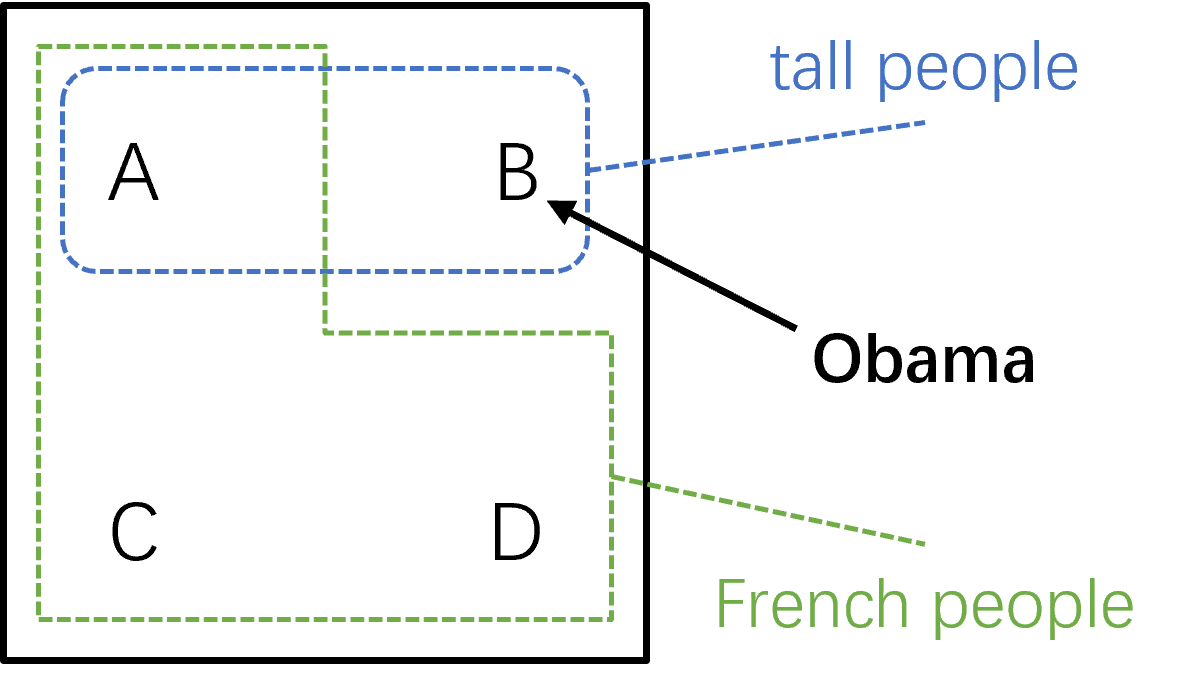
Russell does not endorse this picture
Problem
- Fido is happy
- Some dog is happy
- Every dog is happy
- No dog is happy
Subject of [1] = "Fido"
- it points to "Fido the dog"
Subject of [2/3/4] = "Some / Every / No dog"
- they do not point to specific things, many argue that these subjects point to abstract things
Solution
Distinguish Grammatical & Logical Forms
Examples
Alice is a Queen
Some King is a Queen
Every King loves some Queen
2. "The"
Question
What is "The"?
- Name? (ex. "Alice" "Fido")
- QE? (ex. "Some" "Every")
Russell thinks "The" is a Quantifier Expression (QE), and there is only one
(Uniqueness) when you say "The is " Example
Grammatical Form
The dog is happy
Logical Form
Main Argument
"The
is but there's no " FALSE
"The King of France" does not exist
Comments from other Philosophers:
Meinong
"the King of France" picks out something that does not exist
Ex. The round square is weird - "round square" is a contradiction
Frege
"The King of France has Sense but no Nominatum"
Russell's Comment: Grey's Elegy
No one knows what Russell is referring to
Why think that "The
is " is FALSE rather than Truth-Valueless? Russell thinks: If some part of the sentence is truth-valueless, then how could adding a predicate makes it have a truth-value?
Example
- Assume the son is not drowned
"the only child of mine" does not exist the second half of the sentence is truth-valueless - However, the sentence is TRUE in general
how is it possible for the whole sentence being TRUE while its second half is truth-valueless? (Recall: Frege thinks that Truth-Value of a sentence contributes to that of a bigger Sentence)
3. Sentence Readings
Two different sentence readings
- De Dicto = "of the word"
- De Re = "of the thing"
Examples
De Dicto Sentence
Emphasis: "the President"
this applies to all presidents in the history of the US De Re Sentence
Emphasis: "the Nominatum of the President"
the current president of the US is 79 years old indeed
Logical Forms of the two readings would be presented in the discussion of Russell's Three Puzzles
4. Russell's Three Puzzles
4.1 Frege's Puzzle
Puzzle
if
, then anything that is true of is true of Scott is the author of Waverly
George wondered whether Scott was the author of Waverley
George wondered Scott was Scott
Analysis
According to Frege, switching a Names of the same Nominatum in a sentence should preserve its truth-value. Therefore, [4] should be TRUE
But by the Meaning of Sentence [3] and [4]
- [3] - TRUE
- [4] - FALSE
It is a substitution failure that Truth-Value of the sentence changed
Solution
To avoid the conclusion in [4], Russell promotes the Description Theory of Names on which "Scott" is a Unary Predicate
(as applied to the variable ) instead of a Logical Constant As such, better logical forms of [2] and [3] are
[2] Scott is the author of Waverly
[3] George wondered whether Scott was the author of Waverley
De Dicto
George wondered the following proposition is TRUE: There is one person that is the author of Waverley, and this person is Scott
De Re
There is one person that is the author of Waverley, and George wonders if this person is Scott
4.2 Law of Excluded Middle (LEM)
Puzzle
According to this lemma, we have
But if everything in the world is classified into two categories of
Then you will find "the King of France" in neither of them
Solution
De Re - Incorrect
De Re reading is denying the "property" of the subject, hence it still assumes the existence of the subject (the King of France)
De Dicto - Correct
De Dicto reading is directly denying the existence of the subject (the King of France), hence the meaning of this reading aligns with the Law of Excluded Middle
4.3 Existential Generation
De Dicto - Correct
- If there is no golden mountain, then this is obviously TRUE
- If there are more than one golden mountain, then this is also TRUE because the Uniqueness of "The" becomes invalid
De Re - Does not exist
This does not exist. De Re reading usually places negation inside the Quantifier Expressions, which means it first assumes the existence of a subject and then deny its property.
In this puzzle, it sounds very weird like this