Two Dogmas of Empiricism
Against to two central tenets of Logical Positivists: "The Two Dogmas"
- Analytic / Synthetic Distinction
- Reductionism (Verificationism)
Quine believes that the two dogmas are essentially the same
"The two dogmas are, indeed, at root identical."
1. Dogma 1: The Analytic / Synthetic Distinction
1.1 Analyticity
Definition
is Analytic can be turned into a logical truth by replacing synonyms with synonyms Key Question: What does it mean for a statement to be analytic?
True in virtue of meaning
Quine: "what a meaning is" is difficult to answer
A platonic form? A psychological entity?
If you want to ground all the a priori knowledge by saying that we can reflect / infer everything just by knowing the meaning of words, that does not look good
Because even the meaning of words is empirical matter now
At this point of his paper, Quine is skeptical about meaning
True by definition
Definition? Why should your definition of "Bachelor" as an "Unmarried Man" be the one that holds?
Many people will appeal to the authority of the dictionary for definitions, but
Quine: Dictionary does not stipulate the meaning of words, it is just a reference of existing uses.
True in virtue of synonym
To use Interchangeability (Salva Veritate) Test to define Analyticity
Analytical Truth
Logical Truth
"No married man is not married"
True by Definition
"No married man is a bachelor"
If you sub in "Bachelor" with "Unmarried Man" then it becomes logical truth
If a truth is analytic, then you cannot deny it without contradicting yourself
Analytic Statement
(Two Dogmas of Empiricism)
Quine: "An analytic statement is that limiting case which is confirmed no matter what."
1.2 Salva Veritate & Synonym
Salva Veritate: Two expressions can substitute each other in all contexts without change of Truth-Value
Synonym: If two words can Salva Veritate, then they are synonyms
Example
- No bachelor is tall - FALSE
- No unmarried man is tall - FALSE
Therefore, "bachelor" and "unmarried man" could Salva Veritate, and they are synonyms
Quine: This doesn't work either
Example
I have a bachelor of science in physics
I have a unmarried man of science in physics
I have good penmanship
I have good penadultmalehumanship
Obviously "bachelor of science" or "penmanship" should be viewed as a unit
Naïve Salva Veritate is also not a good test
Example
It turns out that all cordates are renates, and all renates are cordates
You can interchange renate & cordate while keeping the Truth-Value of the sentence
- Tracy is renate - TRUE
- Tracy is cordate - TRUE
BUT renate & cordate are words of different meanings!
- I think Scooby-Doo is renate - TRUE
- I think Scooby-Doo is cordate - FALSE
You are entirely free to believe that Scooby-Doo is a renate but not a cordate, and to determine the Truth-Values of the two sentences based on that belief!
Quine: No! This is illegitimate language!
Two Types of Language
Extensional
The Truth-Value of a sentence ONLY depends on the object (extension) referred to by the words
Substituting co-denoting terms doesn't change Truth-Value
Both extensions of Hesperus and Phosphorus are Venus
Substituting co-extensive predicates doesn't change Truth-Value
In biology, the set of objects (extensions) covered by Renate and Cordate is identical
Intensional
Example
Extensional Definition of "Bachelor"
a listing of all the unmarried men in the world
Intensional Definition of "Bachelor"
"Unmarried Man"
Quine holds that
- Extensional Language is the only legitimate language
- Intensional Language is illegitimate and cannot push science forward
1.3 Necessarily
"Necessarily"
Quine notes that the Interchangeability (Salva Veritate) Test can be improved by introducing "necessarily / it had to be the case", thereby distinguishing genuine cognitive synonyms from words that merely share the same extension
Example
We can show that Renate and Cordate are not synonyms
- It had to be the case that all renate animals are renate - True
- It had to be the case that all renate animals are cordate - False
We can imagine a creature to have a heart but no kidneys, though such a creature does not exist in reality
We can show that Bachelor and Unmarried Man are synonyms
- It had to be the case that all bachelors are bachelors - True
- It had to be the case that all bachelors are unmarried man -True
We cannot image a bachelor who is not an unmarried man, otherwise there would be self-contradiction
However, Quine holds that "necessarily / it had to be the case" is illegitimate
Because when you say "It had to be the case that
" is actually saying that " is an Analytical Truth" Example
- It had to be the case that all bachelors are bachelors - True
- It had to be the case that all bachelors are unmarried man -True
This is an Interchangeability (Salva Veritate) Test
"Bachelors are Unmarried Man" is an Analytical Truth
It is trivial to use Interchangeability (Salva Veritate) to define Analyticity (see 1.1)
Huh???
1.4 Circular Reasoning
This is the circular reasoning we have throughout the problem of Analyticity
Quine concludes that the notion of Analyticity is bunk, and so should be rejected
2. Dogma 2: Reductionism (Verificationism)
All statements can be reduced to sense experience
Quine: Statements cannot get verified or falsified
Corporate Body: You are always pre-assuming things when observing
Quine in Two Dogmas of Empiricism: "... our statements about the external world face the tribunal of sense experience not individually but only as a corporate body."
Example
"Galileo's finding was doubted because of the illusions in the instrument"
This disconfirming statement is actually related to the assumption that the instrument functions properly
Putnam: Stipulation is no different from hypothesis
There's no principle distinction between matter of fact and logical truth
Example
In Newtonian physics, kinetic energy is stipulated by
Centuries later...
In Einsteinian physics, kinetic energy is stipulated by
3. Coherentism (Quine Positive Picture)
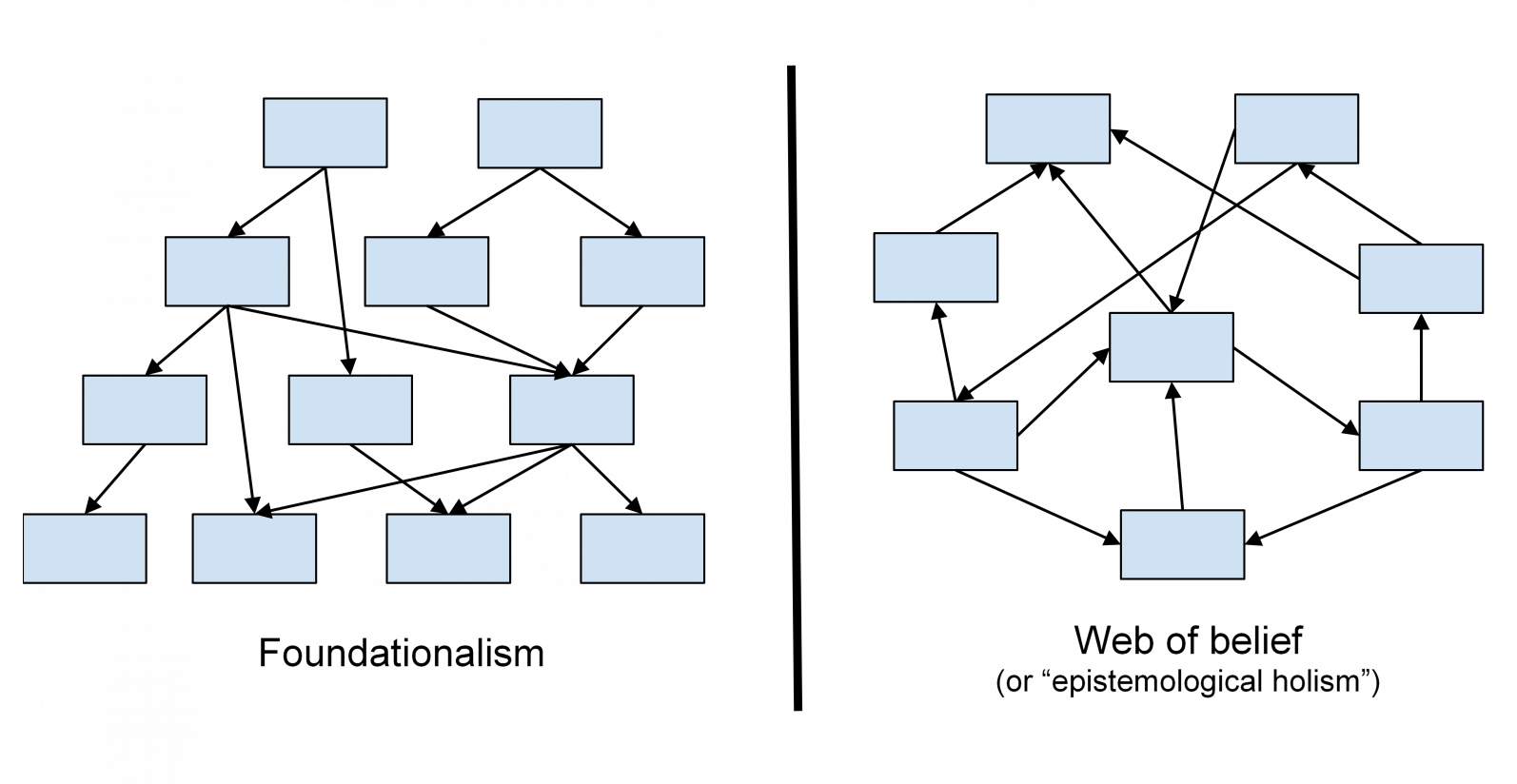
Foundationalism
Traditional picture, the chain of reasoning is like a tree
Coherentism
Proposed in Quine's The Web of Belief, the chain of reasoning is like a network
Every belief is subject to revision
Including those logical beliefs and "analytic truths"
Beliefs differ not in kind but in degree
Kind = analytic / synthetic
Degree = strongly / weakly held
Beliefs at the periphery are less central to our overall belief systems, and so less costly to revise
As such, principles of rationality prima-facie push us to revise those beliefs instead of ones closer to the center
Beliefs towards the outside are such beliefs as
- "There are no centaurs"
- "Electrons exist"
What Quine proposed is different from Logical Positivist: Philosophy and Science are the same